
Charting the algorithm.
Ever wondered how the data you chart impacts artificial intelligence in healthcare? Let’s break it down.
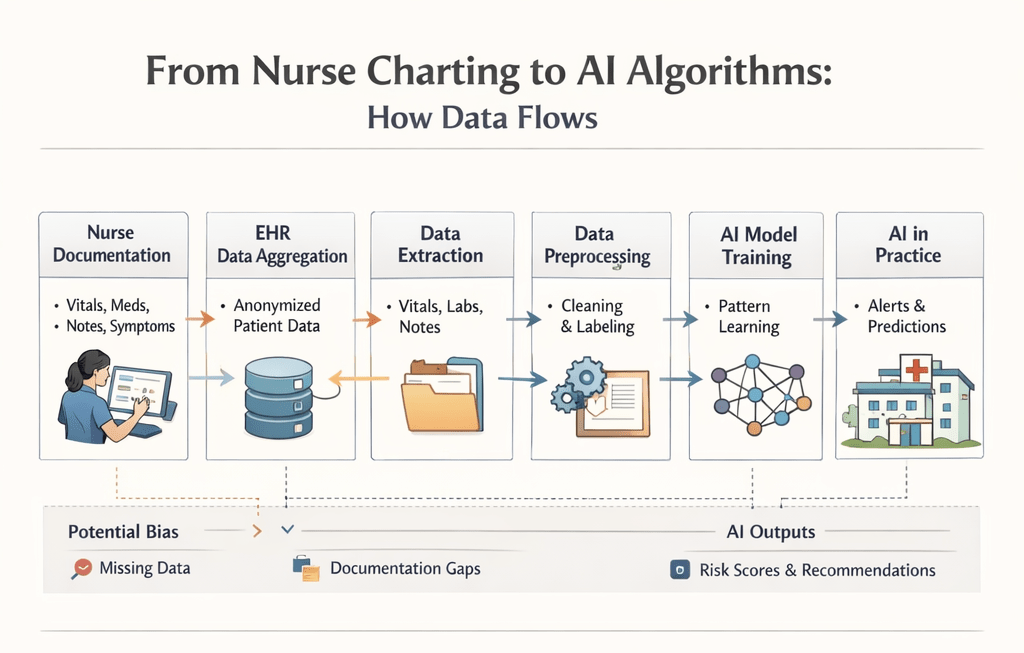
1. Charting at the Bedside
As nurses, you enter vitals, medications, symptoms, and notes into the Electronic Health Record (EHR). This data can be:
- Structured – like blood pressure readings, lab values, or medication codes
- Unstructured – like narrative notes describing patient concerns or subtle observations
What you document here becomes the raw material AI will eventually learn from.
2. From Patient Records to Datasets
EHR systems gather this data into large, often anonymized databases. Structured information is easy for AI to process, but unstructured notes require Natural Language Processing (NLP) to extract meaning. Essentially, AI has to “read” your notes to understand patterns.
3. Building AI Training Sets
Not all data makes it into AI. Data scientists select what matters, clean errors, fill in missing values, and label outcomes (e.g., did the patient develop sepsis? yes/no).
How consistently and accurately nurses document can directly influence what the AI “learns.”
4. Training the AI Algorithm
The AI examines historical data to learn patterns and predict outcomes, such as:
- Which patients are at risk of deterioration
- Who might need extra monitoring
- How certain interventions affect recovery
If nurse documentation is incomplete or inconsistent, the AI can develop biased or inaccurate predictions.
5. AI in the Hospital
Once trained, AI may provide:
- Risk scores and alerts
- Decision support tools for patient care
- Workflow or resource predictions
Every recommendation the AI makes is fed by the data you entered at the bedside. Your documentation shapes its logic.
Takeaway
Your charting is more than record-keeping—it directly influences AI that could impact patient outcomes. Accurate, detailed, and consistent documentation helps ensure AI is fair, reliable, and effective.
Nurses are the first shapers of healthcare AI. Missing data or inconsistencies today can lead to biased recommendations tomorrow.
 Nurse In The Loop